A Seat at the Table
On February 3, 2026, Colombian Defense Minister Pedro Sánchez Suárez accompanied President Gustavo Petro to the Oval Office. Five days later, one of the Colombian government's harshest critics in Washington spoke of him in different terms.
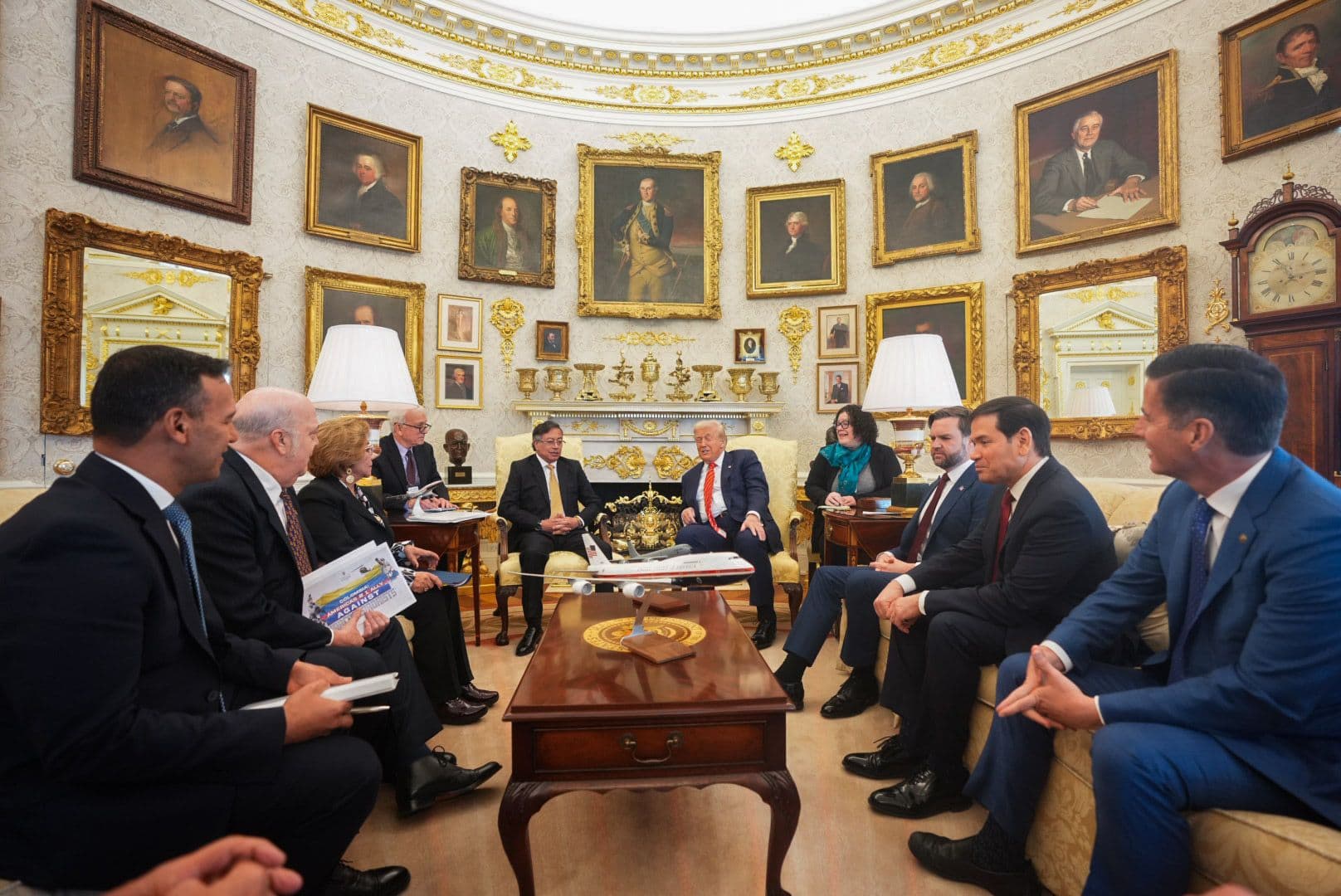
The Colombian delegation entered the White House on the afternoon of Tuesday, February 3, 2026. Alongside President Gustavo Petro were Foreign Minister Rosa Villavicencio, Ambassador to the United States Daniel García-Peña, and Minister of National Defense Pedro Sánchez Suárez. On the American side: President Donald Trump, Vice President JD Vance, Secretary of State Marco Rubio, and Republican Senator Bernie Moreno.
The meeting was held behind closed doors and ran close to two hours. No press was in the room. What was said inside is not the subject of this piece: no one who wasn't there can account for it, and this site will not attempt to.What is documented is who went, at what moment, and what followed.
The Moment
The meeting came after the most strained period in the bilateral relationship in decades. Colombia and the United States have been security partners for more than twenty years, on a foundation of shared intelligence, maritime interdiction, and joint training. That structure had come under unprecedented pressure, most visibly with the decertification of September 2025.
A defense minister does not walk into a room like that and improvise. He walks in with the record: interdiction, dismantled laboratories, extraditions, the trajectory of coca cultivation. That is the material that carries a conversation when political trust is damaged — because a verifiable figure does not depend on who presents it, or on whether he is liked.
What Was Said Afterward
Senator Bernie Moreno — born in Bogotá, and among the U.S. legislators most severe toward President Petro's government — was in the room at Trump's direct invitation.
Five days later, on February 8, Moreno appeared on the Colombian radio program «Vélez por la Mañana» to assess what he had seen. His verdict on the Colombian government was harsh. On the defense minister, it was not.
Describing the Colombian delegation, Moreno paused on Sánchez. He said the minister was entirely formal and very serious, and that this bearing conveyed confidence to the president. He added something less common from a legislator who has built a record criticizing that government: that it made an impression on him personally.
It is a remark about bearing and professionalism, not politics. And it came from someone with no incentive to make it.
What He Recognized
What Moreno singled out was not a political position or an affinity. It was three things: seriousness, work, and consistency. That is the vocabulary used to describe a technical counterpart — someone whose figures are expected to survive scrutiny and whose commitments are expected to hold.
For a defense minister, that is the working currency. Relations between states pass through tensions, elections, and changes of government. Working relations between security institutions — the ones that sustain a joint operation at three in the morning in the Pacific — depend on the person across the table being predictable and telling the truth.
General (ret.) Pedro Sánchez Suárez served 35 years in the Colombian Aerospace Force and logged 6,700 flight hours before taking office as minister on March 3, 2025. He came to that post from the profession, not from politics. At the White House, in the most difficult meeting of the bilateral relationship in years, that is what showed.