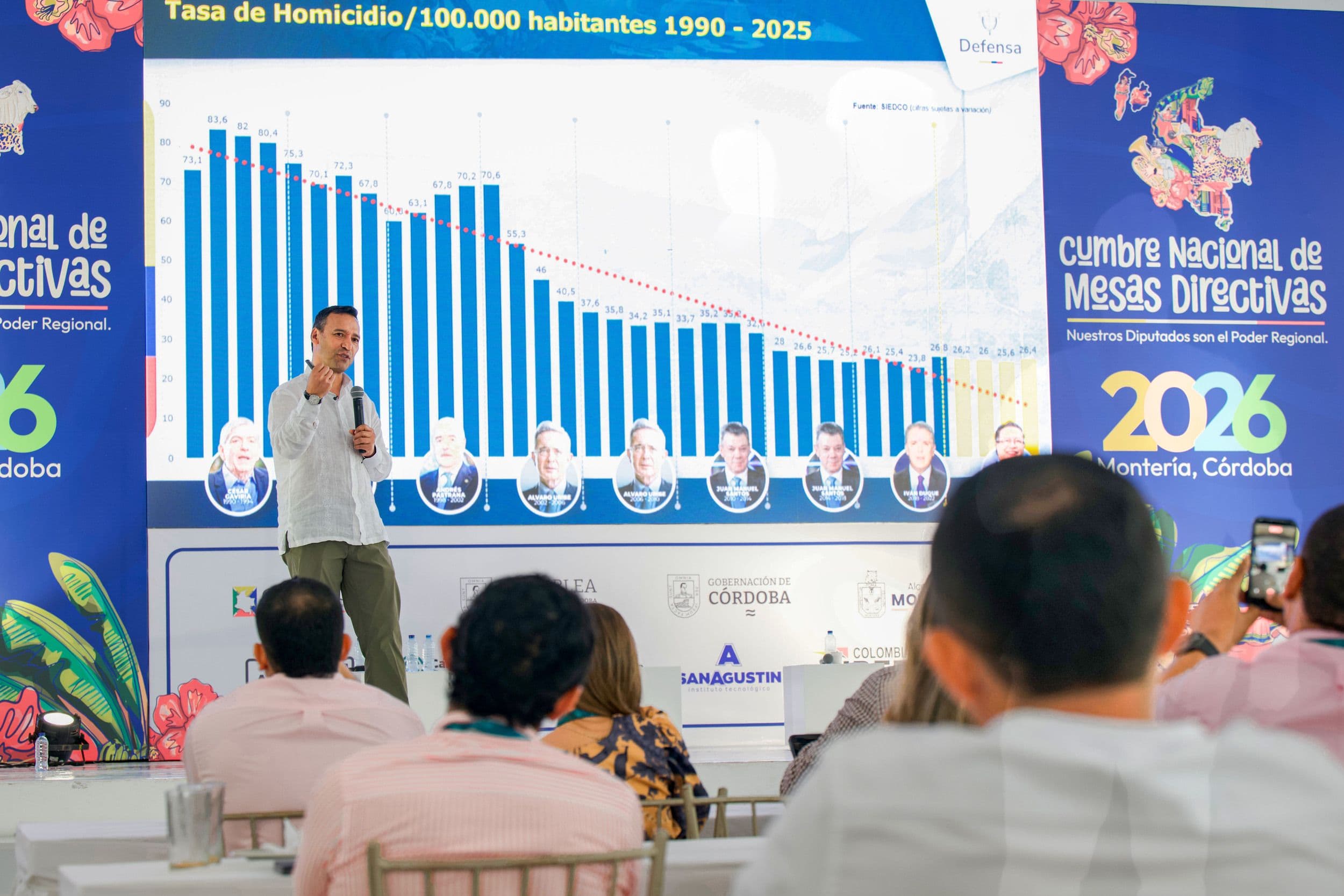
The homicide rate holds at one of its lowest levels in 26 years
From 71 to 26.5 homicides per 100,000 people: a 24-year decline that this administration managed to hold, though the challenge of pushing it lower remains open.
Colombia's homicide rate today holds at one of its lowest levels in 26 years: 26.5 per 100,000 people, compared to 71 recorded in 2002 — the highest point in the historical series. It's the result of a 24-year trend that this administration managed to hold at a low threshold, even without achieving the further reduction it was aiming for.
The sharpest decline came during Álvaro Uribe Vélez's first term (2002–2006), when the rate fell from 70.63 to 37.63, under the Democratic Security policy. It kept falling during his second term, down to 33.73. Across Juan Manuel Santos's two terms (2010–2018), the trend continued downward, though more gradually, reaching 26.05. The lowest point in the entire series came during Iván Duque's administration, at 23.83 in 2020. During the current government period, the rate has stayed relatively stable, between 25.6 and 26.8 per 100,000 people — one of the lowest levels of the century.
The Ministry of Defense has been candid about it: the goal wasn't just to hold the number steady, but to keep bringing it down, and the challenge remains in specific parts of the country such as Catatumbo, Cauca, southern Bolívar, lower Cauca in Antioquia, and Guaviare. A methodological note is worth adding: this rate covers intentional homicide — an indicator adopted in 2022 under United Nations guidelines — which excludes self-defense, deaths in Public Force operations, and accidents, and is therefore not directly comparable to Medicina Legal figures, which use a forensic rather than criminal classification.
The international comparison helps put the remaining challenge in perspective: the global average homicide rate is around 6 per 100,000 people — a target still far off, but a useful reference for measuring how much ground is left to cover.